
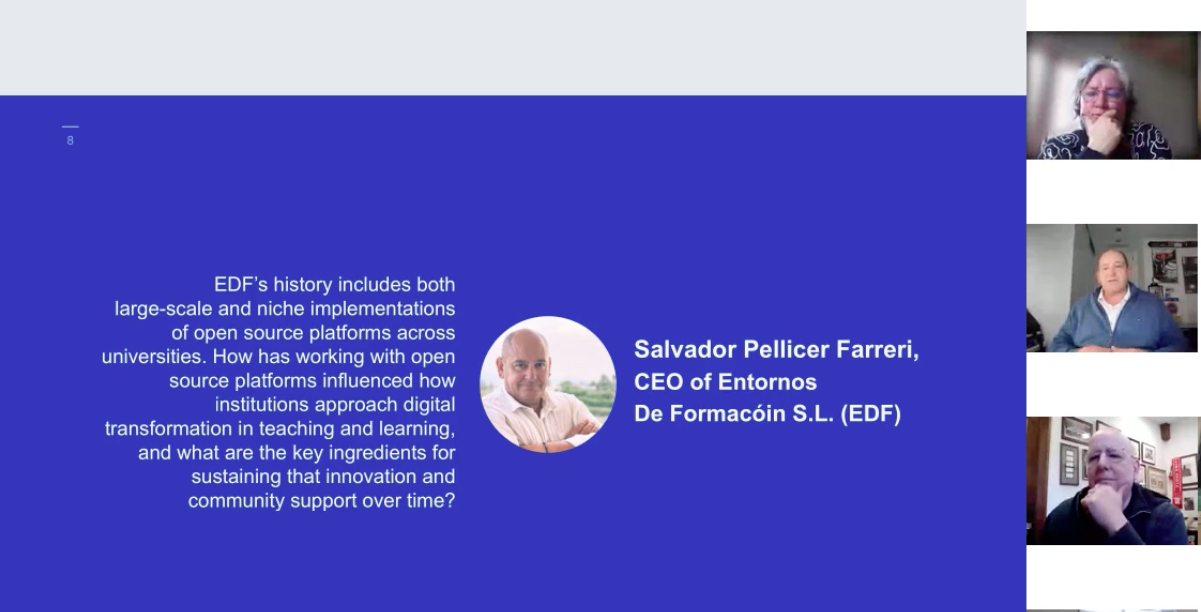
 Salvador Pellicer, CEO of EDF, discussing the challenges of Open Source in Higher Education with the Apereo Foundation.
Recently, last Wednesday, I participated in a Conference with the Apereo Foundation. During this event, we discussed how Open Source shapes innovation in Higher Education. Reflecting on the discussion, I’ve realized that:
1. Open source is not just a technical choice; it is a strategic necessity for institutional sovereignty
The real power of an open ecosystem is that it shifts control. Consequently, it moves from vendor-defined roadmaps to shared governance.
Furthermore, when institutions move from being passive “customers” to active “managers”—as we see in formal groups like S2U in Spain—they stop renting their digital future and start owning it.
By pooling resources, universities can ensure that their technology serves their specific pedagogical goals rather than forcing teachers to adapt to a “pre-defined box” system.
2. To sustain this innovation, it is necessary to act as connectors between local needs and global solutions.
For instance, whether it is solving specific grading challenges or navigating new European data protection policies, the strength lies in the community, therefore we can turn one institution’s improvement into a global asset.
In the current landscape of AI and data governance, Open Source is the most reliable way to ensure that public services remain transparent, secure, and under institutional control.
In conclusion, innovation is not sustained by bigger budgets. Instead, it is sustained by the decision to work together for a shared goal that is guaranteed teaching and learning processes.