
EDTECH INTEGRATIONS
LTI 1.3 and API Integrations to Connect Your Learning Ecosystem
The LTI 1.3 and API integrations we design at EDF remove barriers between your LMS (Moodle, Canvas, Sakai) and the rest of your institutional systems. We apply IMS Global standards, OAuth 2.0, and decoupled architectures to guarantee interoperability, security, and maintainability. Over 15 years connecting educational platforms with third-party tools. See our technical consulting →
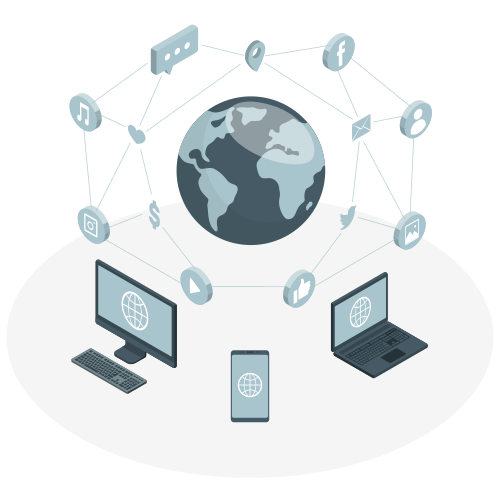
More than 50 complex integrations delivered in production educational environments
LTI 1.3 and API Integrations: the standard that unites your LMS with the world
A disconnected LMS creates manual processes, duplicate data, and a fragmented experience for students and teachers. Our LTI 1.3 and API integrations solve this problem by applying the most advanced interoperability protocols. We connect your Moodle, Canvas, or Sakai with ERPs, CRMs, identity systems, content tools, video conferencing platforms, and any external service that needs to share data securely.
LTI 1.3 and API Integration Services
LTI 1.3 and LTI Advantage Implementation
We configure the complete standard: secure OIDC launch, JWT/JWKS validation, AGS services for grade return, NRPS for role queries, and Deep Linking to insert external resources from the LMS. See our consulting →
REST APIs and Web Services
We expose and consume APIs to synchronize users, courses, enrollments, and grades between the LMS and systems like ERP, CRM, SIS, or mobile applications. Fully documented with error handling. See our custom development →
SSO, SAML, and OAuth 2.0
We unify campus access with corporate identity. We implement Single Sign-On with SAML 2.0, OpenID Connect, LDAP, CAS, and custom OAuth 2.0 flows. Learn about SSO integration →
Automation and middleware
We design intermediary layers to orchestrate processes between Moodle and corporate systems. We automate tasks with queues, jobs, webhooks, and tools like Zapier or Make. 24/7 Support →
Standards we work with
Methodology for LTI 1.3 and API integrations
01
Ecosystem analysis
We identify the systems involved, the necessary data flows, and the most appropriate architecture for each integration.
02
Design and development
We implement the solution following standards, with version control, automated testing, and technical documentation.
03
Validation and deployment
We test in staging, validate security, and support production deployment with a planned rollback strategy.
Frequently asked questions about LTI 1.3 and API integrations
What is the difference between LTI 1.3 and a REST API integration?
LTI 1.3 is designed to launch external tools from the LMS with academic context (user, course, role) securely, without sharing credentials. REST API is better suited for synchronizing bulk data (users, courses, grades) between systems. In many projects, we combine both. See our integration guide →
How long does it take to implement an LTI 1.3 integration?
It depends on the number of tools and required LTI Advantage services. A basic integration can be ready in 3-4 weeks. A complete ecosystem with AGS, NRPS, and Deep Linking may take 6-10 weeks, including regression testing and documentation.
Can you integrate our ERP or CRM with Moodle?
Yes. We have performed integrations with Odoo, SAP, Salesforce, Microsoft Dynamics, and other systems. We use the APIs from both sides and, when necessary, develop custom middleware. See our custom development →
How do you ensure data security in integrations?
We apply TLS 1.3 encryption, robust authentication (OAuth 2.0, JWT), strict token validation, and permission review. All connections are documented and delivered with a risk analysis aligned with ISO 27001.
What happens if Moodle is updated? Does the integration break?
Our integrations are designed using official APIs and standards like LTI 1.3, which minimizes the risk of breakage. Additionally, we offer 24/7 technical support that includes compatibility reviews before each LMS update.
Ready to connect your LMS with the rest of your ecosystem?
Schedule a diagnostic session. We will analyze your current infrastructure and deliver a detailed integration plan with the best technical options for your case.