
EdTech Consulting and eLearning Architecture for Scalable, Secure, and Interoperable LMS
At EDF, we help universities, training centers, public administrations, and companies design, audit, and evolve their eLearning ecosystems. Our EdTech consulting combines LMS architecture, LTI 1.3 integrations, APIs, security, performance, and scalability so your virtual campus operates stably, interoperably, and is ready to grow. Learn about our approach →
STRATEGIC CONSULTING · LMS ARCHITECTURE · INTEROPERABILITY
Initial diagnosis at no cost. First indicative analysis within 5 business days after receiving the necessary technical information.
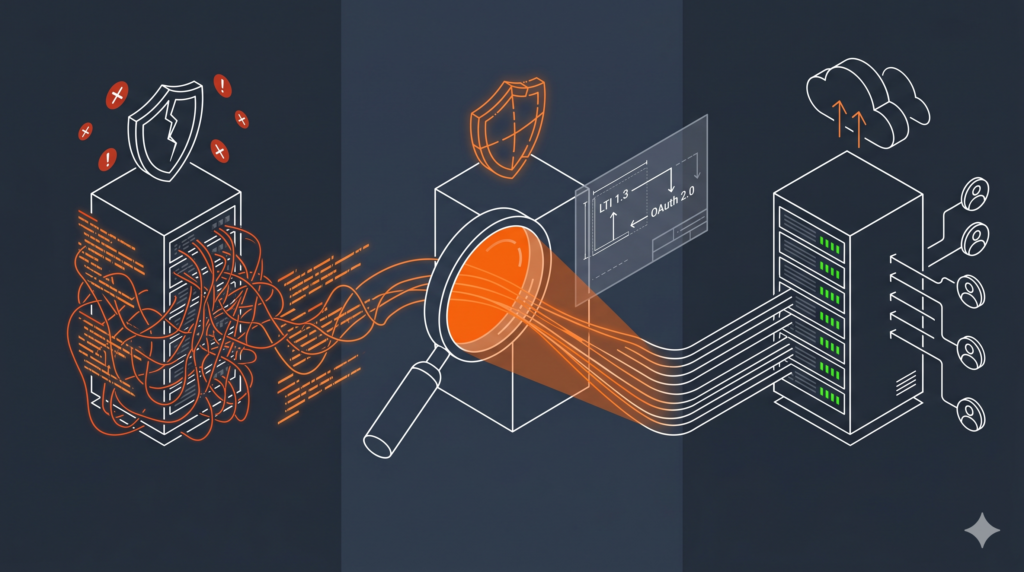
Experience, security, and interoperability for critical eLearning projects
Why EDF brings real authority in EdTech consulting
eLearning architecture is not solved by infrastructure alone. It requires expertise in LMS, interoperability standards, security, academic data, operational support, and educational product evolution. Furthermore, it needs an integrative approach that connects all these layers.
Institutional Experience
We work with universities, training centers, public administrations, and companies that need stable, documented eLearning platforms ready for critical processes.
Technical Specialization
Our team combines LMS development, LTI integrations, APIs, cloud architecture, support, security, automation, migrations, digital content, and technical governance of the ecosystem.
Verifiable Trust
We reinforce each project with documentation, traceability, diagnostic methodology, real references, commitment to EdTech standards, and information security best practices.
Common problems we solve on eLearning platforms
Our EdTech consulting and eLearning architecture helps you diagnose and resolve these issues in a structured way, before they affect your virtual campus operations.
Slow or unstable LMS
We perform a comprehensive performance analysis: database, caches, cron, plugins, storage, server configuration, and behavior during academic activity peaks.
Fragile integrations
Furthermore, we review LTI 1.3 connections, REST APIs, SSO, user synchronization, grades, content, external tools, and interoperability flows.
Accumulated technical debt
We also detect obsolete plugins, legacy developments, undocumented dependencies, update risks, and blockages that make it difficult to evolve the virtual campus.
EdTech consulting services for LMS architecture, security, and interoperability
We address the root problems of your LMS before they become critical incidents, cost overruns, or operational blockers.
LMS Technical Audit
We carry out a technical X-ray of Moodle, Canvas, Sakai, Blackboard, or other eLearning platforms. We review configuration, extensions, security, performance, logs, integrations, database, deployment architecture, and future version compatibility. See methodology →
LTI 1.3 and API Integrations
We design integrations based on LTI 1.3, Advantage, Deep Linking, Assignment and Grade Services, Names and Role Provisioning Services, REST APIs, OAuth 2.0, and SSO flows. The goal is for your educational tools to work as a coherent, secure, and maintainable ecosystem. See integrations →
Scalability and High Availability
We design cloud, hybrid, or on-premise architectures prepared for exam peaks, enrollments, submissions, and training campaigns. We work with load balancing, caching, monitoring, backups, service separation, observability, and contingency plans. See support and evolution →
What our eLearning architecture diagnosis includes
EDF’s EdTech consulting and eLearning architecture diagnosis turns technical review into actionable decisions: risks, priorities, quick wins, roadmap, and recommendations for management, IT, and academic teams.
1. Technical map of the ecosystem
We document LMS, external tools, authentication, integrations, data flows, dependencies, infrastructure, technical roles, and risk points.
2. Risk assessment
We prioritize incidents by impact, urgency, and effort: security, availability, performance, maintenance, user experience, and interoperability.
3. Evolution roadmap
We deliver a roadmap with immediate actions, medium-term improvements, complexity estimates, and technical recommendations to reduce debt and scale.
Decision-oriented EdTech consulting and eLearning architecture methodology
Each intervention is structured so that management, IT, and academic teams can decide with evidence, not intuition.
Phase 1 · Discovery
We gather functional context, system map, objectives, constraints, available documentation, versions, active integrations, recurring incidents, and institutional priorities.
Phase 2 · Technical analysis
We review LMS configuration, plugins, performance, security, logs, integrations, infrastructure, database, scheduled processes, authentication, and critical dependencies.
Phase 3 · Action plan
We prioritize findings, risks, and improvements in a technical roadmap with quick wins, corrective actions, architectural decisions, and sustainable evolution recommendations.
Measurable results in eLearning architecture and EdTech consulting
These indicators reflect the impact of our EdTech consulting and eLearning architecture on real projects. Furthermore, all of them are backed by the traceability of our interventions.
+1.5M
Users managed
on platforms, services, and educational ecosystems designed, maintained, or evolved by EDF.
+15
Years of experience
in online training projects, LMS, digital content, interoperability, and technical support.
24/7
Support and monitoring
for critical environments with needs for continuity, traceability, and incident response.
eLearning architecture led by LMS technical specialists
Behind each diagnosis is a team with real experience in institutional environments, LMS platforms, software development, integrations, support, security, and operation of eLearning services. We do not outsource technical judgment: we document decisions, risks, and alternatives so that your team can understand, prioritize, and govern the evolution of the virtual campus.
Strategic vision and technical depth
- Internal team with experience in Moodle, Canvas, Sakai, LTI 1.3, SCORM, xAPI, APIs, and cloud architecture.
- Ability to work with management, IT, teaching, support, academic administration teams, and external vendors.
- Deliverable technical documentation, prioritized roadmap, and support during the implementation of improvements.
Consequently, this approach combines strategic vision and technical depth: server architecture, performance, security, interoperability, user experience, data governance, and sustainability of the eLearning ecosystem.
Clients and partners endorsing our EdTech experience
Technical authority is demonstrated through real projects. These testimonials come from institutions, universities, and technology partners who have worked with EDF on LMS, LTI, Sakai, online training, and educational digital solutions.
Institutional testimonials
“At Grupo PROEDUCA, we have been collaborating with EdF for more than 3 years on the development, evolution, and maintenance of some of our educational solutions and integrations, always with optimal and professional results.”
Carlos Muñoz
Director | Grupo Proeduca (UNIR)
Testimony especially relevant for LMS development, evolutionary maintenance, and educational integration projects.
“The work they did for us was in a Sakai environment (Java/Spring/Hibernate) and IMS LTI, and I would not hesitate to count on them for any IT project.”
Adam Marshall
Dr A C Marshall, WebLearn Service Manager, University of Oxford
Testimony aligned with LMS architecture, Sakai, IMS LTI, and EdTech interoperability.
Projects and partners
“We had the opportunity to work with the Entornos team on an online training consulting project that concluded very satisfactorily for Florida.”
Jose Ignacio Ortolá
CIO Florida Universitària
Testimony oriented towards online training consulting, institutional support, and eLearning transformation.
“Working with EdF, as partners in the European project JuezLTI, has been a highly enriching experience.”
Francisco José Hernández Pérez
Director of CIFP Carlos III (Cartagena)
Testimony linked to European projects, educational digital tools, and development of sustainable platforms.
Security and privacy in EdTech consulting and eLearning architecture
An eLearning ecosystem manages identities, grades, learning evidence, activity logs, and academic data. That’s why we treat security as part of the architecture, not as a final review.
Access governance
We review roles, permissions, authentication, SSO, sessions, logs, traceability, and endpoint exposure to reduce technical and operational risks.
Data protection
We work with confidentiality and data processing agreements when the project requires it, following best practices aligned with GDPR and educational environments.
Service continuity
We design backups, monitoring, alerts, contingency plans, and recovery strategies to minimize the impact of critical incidents.
Frequently asked questions about EdTech consulting and eLearning architecture
How is an EdTech audit different from an internal IT review?
An internal review typically focuses on known incidents. Our audit incorporates an external perspective on architecture, security, performance, integrations, technical debt, documentation, scalability, and governance of the LMS ecosystem. The result is not just a list of problems, but a prioritized roadmap for making technical and strategic decisions.
Which LMS platforms can you audit or evolve?
We work with Moodle, Canvas, Sakai, Blackboard, and LMS ecosystems connected to external tools. We also audit hybrid architectures, custom solutions, platforms with LTI 1.3 integrations, REST APIs, identity systems, SCORM/xAPI content, and third-party tools.
When is it appropriate to request eLearning architecture consulting?
It is appropriate to request it before a major migration, an LTS update, a critical integration, a tender, a planned peak activity, a vendor change, a security audit, or when the LMS starts showing symptoms of slowness, instability, or lack of maintainability.
How long does a complete LTI 1.3 integration take?
It depends on the number of tools, LTI Advantage services involved, data flows, security requirements, and necessary testing. A limited integration can be resolved in a few weeks, while a complete ecosystem requires analysis, design, implementation, validation, documentation, and support during deployment.
Do you work with institutions that are not in the cloud?
Yes. We diagnose on-premise, cloud, and hybrid environments. We do not push a specific technology: we analyze constraints, budget, internal team, service criticality, and growth needs to recommend the most suitable architecture.
What standards help ensure interoperability?
Depending on the case, we use standards like LTI 1.3, LTI Advantage, OneRoster, xAPI, SCORM, and REST APIs. We also review OAuth 2.0, OpenID Connect, SAML, user synchronization, grades, content, roles, and events to ensure interoperability is stable and maintainable.
How do you protect student and teacher data during an audit?
We limit access to strictly necessary information, document interventions, work with confidentiality and data processing agreements when applicable, and apply security best practices aligned with educational environments and data protection requirements.
What does the client receive upon completion of the diagnosis?
The typical deliverable includes a technical map, findings, evidence, risk matrix, quick wins, recommendations, a prioritized roadmap, identified dependencies, and next steps. The level of detail adapts to the scope of the consulting and the profiles that need to make decisions.
How can I request the initial diagnosis?
You can fill out the contact form or write to our team. We will coordinate an exploratory session to understand the context, identify the systems involved, and define what technical information we need to review.
Technical coverage for critical eLearning projects
We support educational institutions, public administrations, training companies, and corporate teams that need stability, expert support, and continuous evolution capability.
Europe
Technical office, development, consulting, and support for institutional and corporate eLearning projects.
Support and evolution
Monitoring, maintenance, updates, incident management, continuous improvement, and technical support.
Latam and international projects
Experience in distributed projects, multicultural teams, remote support, and educational ecosystems with interoperability needs.
Is your LMS ready for the next peak activity?
Schedule a diagnostic session with our team. We will analyze your current architecture, main risks, and improvement opportunities to deliver a roadmap with clear priorities.